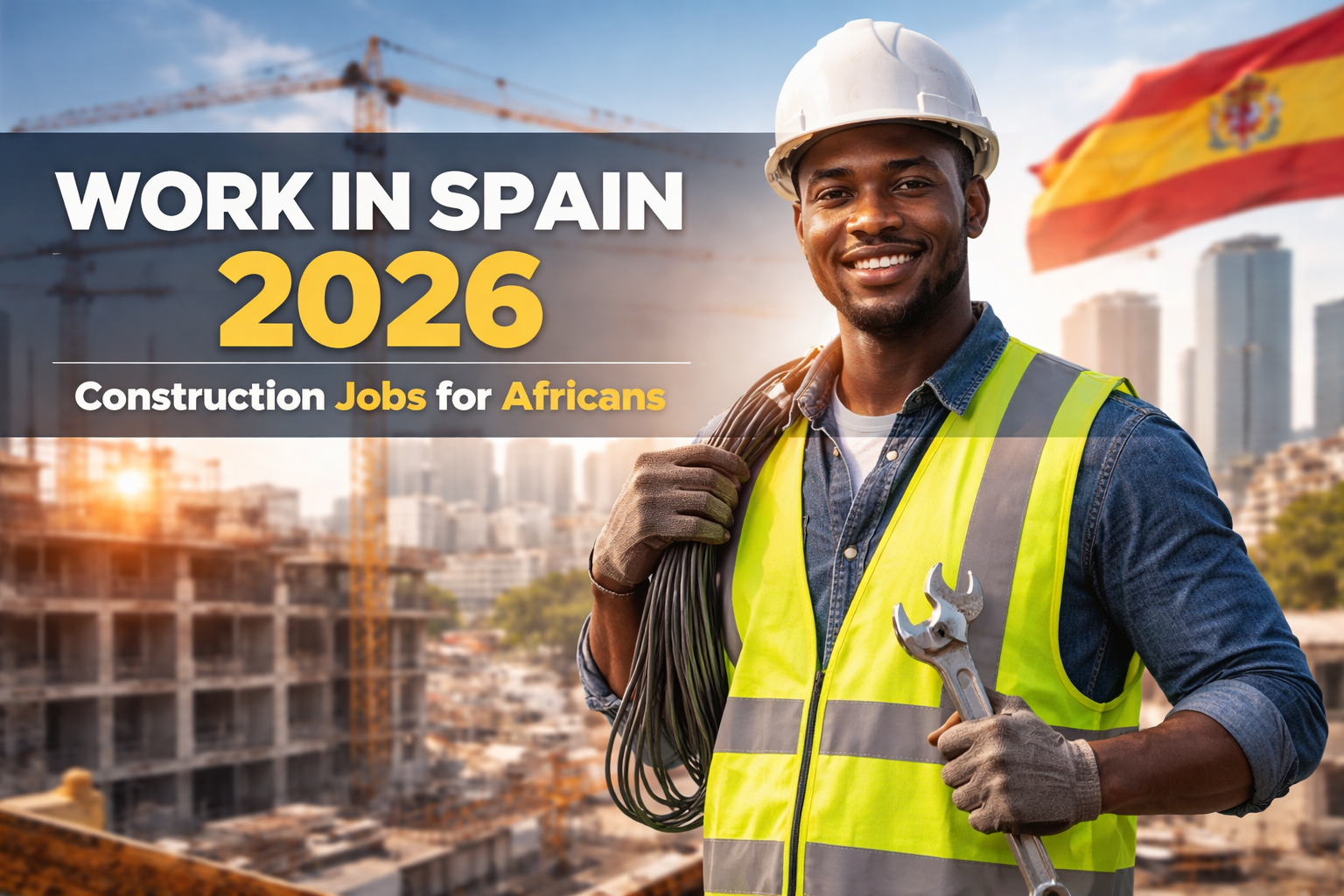
Spain is quietly becoming one of Europe’s most accessible destinations for skilled African workers — and 2026 may be the most strategic year yet to make your move.
Over the last decade, Spain’s construction sector has faced a growing labour crisis. An aging local workforce, coupled with an ambitious national infrastructure agenda and a post-pandemic housing boom, has left Spanish employers scrambling to fill roles that Europeans simply aren’t taking up fast enough.
This isn’t hype — it’s economic reality. The Spanish government has responded by expanding legal immigration pathways, and African workers — particularly those with hands-on vocational skills — are increasingly in demand. This guide walks you through everything you need to know to pursue this opportunity legally and successfully.
Why Construction & Skilled Trades Jobs Are in High Demand in Spain (2026)
An Ageing Workforce Is Leaving a Skills Gap
Spain’s construction workforce is ageing rapidly. A large proportion of experienced tradespeople — electricians, plumbers, welders, and carpenters — are retiring, and younger Spanish workers are not entering the trades at the same rate. This has created a structural shortage that cannot be filled internally.
Industry forecasts indicate Spain will need hundreds of thousands of new construction workers over the next five years to sustain planned projects and meet housing demand.
Infrastructure Investment Is Driving Demand

Spain is in the middle of a major infrastructure expansion. The government’s national housing plan, renewable energy construction projects, and EU-funded urban regeneration programmes are all generating consistent demand for workers. For skilled tradespeople from Nigeria, Ghana, Senegal, Kenya, and across Africa, this is a real and legally accessible window.
Top In-Demand Construction & Trade Jobs in Spain
The following roles represent the highest-demand positions in Spain’s construction sector in 2026, along with typical annual salary ranges:
| Job Role | Average Annual Salary (€) |
| Electrician | €25,000 – €38,000 |
| HVAC Technician | €26,000 – €40,000 |
| Plumber | €22,000 – €35,000 |
| Welder | €23,000 – €36,000 |
| Carpenter / Joiner | €20,000 – €30,000 |
| Construction Labourer | €18,000 – €24,000 |
Roles requiring certification (electricians, welders, HVAC) face less competition and command higher wages. If you have the opportunity to pursue formal training in these trades, prioritise them.
Requirements for Nigerians & Africans: What You Need
Also see: https://job.novaline.com.ng/2026/02/19/construction-jobs
Dangote Job Vacancies 2026: Confirmed Current Openings, How to Apply, and Requirements
Skills, Experience & Certifications
Spanish employers want to see the following:
- Relevant work experience — typically 2–5 years in your trade
- Vocational or technical training certificates from an accredited institution
- International certifications where applicable (e.g. ISO 9606 for welders)
- Verifiable employment history with reference contacts
The Importance of Vocational Training
Before applying, enrol in a formal vocational training programme if you haven’t already. In Nigeria, NABTEB and NBTE-accredited polytechnics issue certificates that can be presented to employers and immigration authorities. Document everything — this paperwork matters significantly during visa processing.
Spanish Language Basics
You do not need to be fluent in Spanish to get a construction job. However, basic Spanish (A1–A2 level) will significantly improve your chances. On a worksite, safety instructions, team communication, and employer interviews are all conducted in Spanish. Free resources like Duolingo, YouTube, and BBC Languages are a solid start.
Work Visa Options for Spain (2026)
1. Employer-Sponsored Work Permit
This is the most common route. A Spanish employer applies on your behalf for a work and residence permit. The employer must demonstrate that the role cannot be filled by a local or EU worker — a condition increasingly easy to satisfy in construction.
- Requires a signed job offer or employment contract
- Proof of qualifications and experience required
- Clean criminal record certificate needed
- Processing time: approximately 1–3 months
2. Seasonal Work Visa (Visado de Temporada)
For temporary or project-based construction work lasting 3–9 months. This is a good pathway for those who want to test working in Spain before committing to a long-term move. You work for the defined period and return home afterwards.
3. Job Seeker Visa (Visado para Búsqueda de Empleo)
Spain’s job seeker visa allows qualified professionals to enter the country and search for work for up to 3 months. You must demonstrate professional qualifications and financial means to support yourself during your search. Works best for candidates with strong, documented skills.
Important Warning
All visa applications must be submitted through the Spanish Consulate or Embassy in your country. Do not pay agents or middlemen who claim to guarantee visas. No one can guarantee visa approval. Always use official channels
How to Get a Construction Job in Spain: Step-by-Step
- Assess and document your skills — gather certificates, employment letters, and training records. Arrange certified Spanish translations.
- Learn basic Spanish — invest at least 2–3 months before applying. It strengthens your CV and improves interview performance.
- Build a European-style CV (Curriculum Vitae europeo) — use the free Europass template at europass.eu. Include a professional photo, reverse-chronological work history, and a brief personal statement.
- Apply to jobs online — use the platforms listed in the next section. Tailor each application to the specific role.
- Secure a job offer — once an employer is interested, work with them on the work permit application. Reputable companies will be familiar with the process.
- Apply for your visa — submit your application at the Spanish Embassy with all required documents. Do not travel without a valid visa.
- Arrive, register, and work — register at your local Ayuntamiento (town hall) and obtain your NIE (Foreigner Identification Number) for banking, tax, and employment.
Best Websites to Find Construction Jobs in Spain
- InfoJobs (infojobs.net) — Spain’s largest job platform with extensive construction listings
- LinkedIn — effective for employer networking and skilled trade roles
- EURES (eures.europa.eu) — the official EU job portal, specifically designed for workers from outside the EU
- Indeed España (indeed.es) — large volume of construction and trade listings
- Milanuncios (milanuncios.com) — popular for manual and trade work
- Manpower Spain / Adecco — large staffing agencies with construction sector placements
Tip: Apply directly to major Spanish construction companies (constructoras). Search for firms like Ferrovial, ACS Group, Sacyr, and regional firms in Madrid, Barcelona, Seville, and Valencia. Many post vacancies directly on their websites.
Salary Expectations vs. Cost of Living in Spain
Construction salaries in Spain range from approximately €18,000 to €40,000 per year depending on your role and experience. The Spanish national minimum wage in 2026 is approximately €1,134 per month. Below is a realistic breakdown of monthly living costs:
| Monthly Expense | Estimated Cost |
| Shared apartment rent (outside city centre) | €400 – €700 |
| Food & groceries | €200 – €350 |
| Transport (monthly pass) | €40 – €80 |
| Utilities & phone | €80 – €120 |
| Total Estimate | €720 – €1,250 |
A construction worker earning €1,500–€2,500 per month can live comfortably in most Spanish cities, save money, and send remittances home. Cities like Valencia, Seville, and Murcia offer lower costs of living than Madrid or Barcelona while still providing strong construction job markets.
Challenges to Expect — and How to Handle Them
Language Barrier
Spanish is the primary language of work and daily life. Without at least basic Spanish, integration will be difficult. Start learning now — not after you arrive.
Competition with EU Workers
EU citizens have the right to work in Spain without a visa. Employers must prove they could not hire an EU worker before sponsoring a non-EU applicant. This adds time and paperwork but is achievable, especially in shortage occupations like electrical and HVAC work.
Legal Process Complexity
Spain’s immigration system requires patience. Expect delays and document requests. Using official government sources and reputable legal advisors is essential. Avoid visa agents who promise guaranteed results for large fees.
Cultural Adjustment
Spanish work culture, climate, food, and social norms are different from West Africa. Going in with realistic expectations makes the transition smoother. Many Nigerians and Ghanaians are already building successful lives and careers across Spain — you will not be starting from zero.
Tips to Increase Your Chances of Success
- Get certified before you apply — documented skills are more credible than verbal claims of experience
- Target shortage occupations — electricians, welders, and HVAC technicians face less competition
- Learn Spanish — even A1–A2 level fluency dramatically increases employability
- Apply directly to construction companies, not just job boards
- Use the EURES portal — it is designed specifically for non-EU workers seeking EU employment
- Build a LinkedIn profile with skills and certifications listed in both English and Spanish
- Be patient with the visa process — plan at least 3–6 months ahead
Applicant Checklist: Are You Ready?
Before submitting any applications, confirm the following:
- I have 2+ years of verifiable experience in my trade
- I have copies of all relevant certificates and training documents
- My documents are translated into Spanish (or I am arranging this)
- I have completed basic Spanish language training (A1–A2 level)
- I have a Europass CV ready
- I have applied through official job platforms (EURES, InfoJobs, LinkedIn)
- I have a clean criminal record with police clearance certificate
- I have a valid international passport with at least 12 months remaining
- I understand the visa type I am applying for and the full process
- I have applied directly to the Spanish Embassy in my country
Frequently Asked Questions
Can I get a construction job in Spain without speaking Spanish?
Technically yes, but practically it is very difficult. Spanish is required for site safety, team communication, and interviews. Basic Spanish (A1–A2) is strongly recommended before you apply.
How long does it take to get a Spanish work permit?
The employer-sponsored work permit typically takes 1–3 months to process once all documents are submitted correctly. Incomplete applications cause the most significant delays.
Do I need an agent or immigration consultant to apply?
No. You can apply directly through the Spanish Embassy in your country. Be cautious of agents who charge high fees and guarantee visa approval — no one can legally guarantee this outcome.
Is my Nigerian vocational certificate recognised in Spain?
It may be accepted by employers, particularly when combined with strong work experience. For regulated professions, a formal recognition process may be required. EURES and the Spanish Embassy can provide guidance specific to your qualification.
Can my family join me in Spain?
Yes. Once you have a valid work and residence permit, you can apply for family reunification after a qualifying period — typically 12 months of legal residence.
What if my visa application is rejected?
You can appeal or reapply with stronger documentation. Seek advice from a qualified immigration lawyer. Many first-time rejections result from missing or incorrectly formatted documents, not fundamental ineligibility.
Conclusion: A Real Opportunity for Those Who Prepare
Spain’s construction sector needs skilled workers, and African professionals — including Nigerians — are increasingly part of that workforce. The legal pathways are real, the salaries are liveable, and the long-term residency and career opportunities are genuine.
Success requires preparation: documented skills, basic Spanish, a proper CV, and patience with the visa process. Those who approach this opportunity with discipline and realistic expectations will find Spain a genuinely rewarding destination.
Do not fall for illegal shortcuts or visa scams. The legal route may take longer, but it is the only route that leads to a stable, dignified life and career in Spain.
Start preparing today. The opportunity in 2026 is real — and it belongs to those who are ready.